
REASONINGS — the written voice of SHAKESCITY.
There has to be a reason.
Kabaka is the proof the cure exists.
There has to be a reason why Black music always starts positive, then it gets likkle edgy, then it gets really, really wacky. I've watched it happen twice in one lifetime, in two different genres, and it's the same story both times. Same arc. Same fall. That can't be an accident.
Let me take you back.
Hip-hop was a genre about Black empowerment. It was about being Black and powerful and wearing Africa on your chest. There was a time weed-smoking was frowned upon on wax. A time you would never call a woman out her name — you loved your Black woman, you protected her. KRS-One and Rakim laid down what we now call Black excellence. RUN-DMC broke the barrier down — physically, mentally, visually — on a platform that didn't even want to show hip-hop videos. A platform you loved. It's called MTV.
Then something started to happen.
Artists started to battle. Studio recordings leaked into the street. Now we got murder, we got drama. I went to bed one night and woke up and KRS-One was gone — now it's N.W.A. running the streets. And I have to ask: after watching Public Enemy, after KRS and Rakim showed us the blueprint for consciousness — why would a Black rap group give themselves that name? Why would we take a step backwards? Knowing how our leaders were killed, knowing what we were fighting for — why would we stop the fight for equality and start calling ourselves the very word that hurts us the most?
Now hip-hop is poppin' pills and calling women bitches. And nobody blinks.
Call me a conspiracy theorist all you want. But tell me why the exact same playbook is running in reggae.
From Bob Marley to Skeng. From consciousness to pill-popping, damn near overnight. From Roots, Reality and Culture to a bag of silliness. I know I can't be the only one who sees it.
Now — I'll be straight with you, because I want this to hold up. It was never a clean line down. Yellowman and Brigadier Jerry rocked the same sound system in the '80s — slackness and culture breathing side by side. N.W.A. and KRS sat on the same record store shelf the same year. The tension was always there. So the real question isn't "when did the music go bad." The music never went all the way bad. The real question is: who got handed the megaphone, and what did the megaphone decide to pay for?
That's where I land, and you don't need a secret meeting to get there. You need incentives. Labels are businesses. Violence, sex, and beef sell cheaper, spread faster, and don't require the artist to have a single thing to say. Put a gatekeeper in charge who has no roots in Kingston or the Bronx — no skin in whether the community lives or dies — and he'll optimize for what keeps you scrolling, not what keeps you free. Run that machine twenty years and you get exactly this. Nobody had to conspire. It's just math.
And I'll give the youth their due too, because the mirror is real. Some of that darkness in the music isn't manufactured — it's a garrison youth documenting the actual thing he woke up in. Funerals, poverty, no exit. It's a reflection. And it's being amplified by people who profit off keeping it a reflection forever. Both true at the same time. That's what makes it a virus and not just a villain.
So — is Kabaka Pyramid the cure?
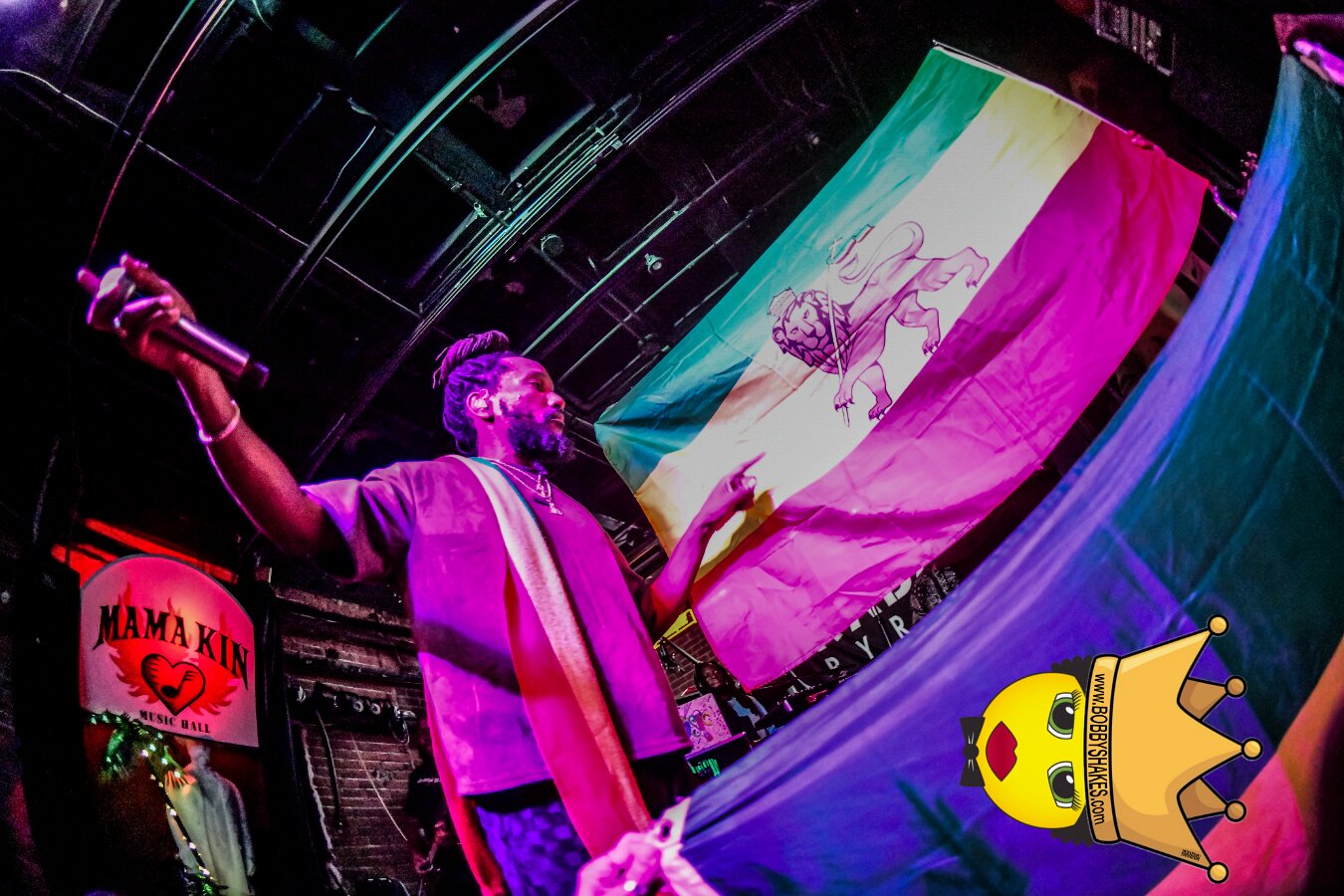
Here's a man who feels anti-establishment. Anti-noise. Carrying the Rasta flag when it would be easier to cash the check. He's burning a fiyah. He's fighting the fit.
And here's the part that should stop you cold: he won a Grammy without pumping up nobody's pum-pum. The Kalling took Best Reggae Album at the 2023 Grammys — his first — produced by Damian "Jr. Gong" Marley, over Koffee, over Sean Paul, over Shaggy, over Protoje. Fifteen tracks of consciousness. No gun tune. No cheap bait. Just sweet reggae music with a live band, standing up straight against all that noise — and winning. "We just some kids from Kingston," he said when he lifted it. You don't have to cower. You don't have to bend to pressure. You don't have to sell the silliness to get the accolade. He proved it.
But let me correct my own self, because I want to leave you with something bigger than one man.
Kabaka is not standing alone. It felt that way in a half-empty room in Boston — and that broke my heart, I won't lie to you. But he's carrying a flag a whole generation is holding up: Chronixx, Protoje, Koffee, Jesse Royal, Lila Iké — the whole Reggae Revival. You can silence one prophet. You cannot assassinate a movement.
So no — Kabaka isn't "the cure."
Kabaka is the proof the cure exists.
And that Boston room? Don't you dare read those empty seats as a verdict on the music. That's not a quality problem. That's a reach problem — a marketing failure, a promoter failure, a we-didn't-tell-enough-people failure. The music showed up. The room just didn't know it was coming.
That's the whole fight, right there. It was never only about making the conscious music. It's about making sure the room hears it coming over all the noise the machine is paying to blast at them.
That's why we market hype.
Burn a fiyah. Tag yourself and share so others can tag and share.